three stories to reflect on
The sexual ethic on offer in our own era should make Catholics particularly skeptical. That ethic regards celibacy as unrealistic while offering porn and sex robots to ease frustrations created by its failure to pair men and women off. It pities Catholic priests as repressed and miserable (some are; in general they are not) even as its own cultural order seeds a vast social experiment in growing old alone. It disdains large families while it fails to reproduce itself. It treats any acknowledgment of male-female differences as reactionary while constructing an architecture of sexual identities whose complexities would daunt a medieval schoolman.From the Economist, “An entrepreneur brings professional grieving to eastern Congo”:
Deborah Nzigere, a 65-year-old Congolese woman, is nervous when she sits down for her job interview. Her hands are clasped tightly together, her words are slow and deliberate; she is blinking too much. “What inspired you to pursue this career?” asks one of the two people on the interview panel. Her answer is garbled, she mentions money. When asked to give a demonstration, she giggles awkwardly and leaves the room. She comes back in crying.Christopher Mims in the WSJ:“Bettina,” she howls and throws herself to the ground. “Bettina, Bettina, why did you leave us?” She thumps the floor with a flattened palm, her body convulses with sobs as she moans and wails. The interviewer’s eyes fill with tears. Mrs Nzigire has got the job.
Through Papa, college-age young people can sign up to help seniors by going to the store, doing housework or just hanging out. For these “pals,” Papa works on the same gig-economy model as Uber or Postmates. Ten hours a week of Papa service is covered for members of Humana ’s Medicare Advantage insurance who are in a pilot program in and near Tampa.Ms. Sumkin’s Papa pals take her on trips to the store since she can no longer drive, and they also help combat her loneliness. Ms. Sumkin says that, aside from occasional visits with her children and grandchildren, her only regular human contact is a bi-weekly stretching class and time with those insurer-provided friends. “They’re all very nice and, you know, I’ll converse with them and find out what they’re doing and studying and so forth,” she says. “It’s for me a very important service.”
stock and flow in newsletters
A few years ago my friend Robin Sloan wrote a post in which he applied the economic concept of “stock and flow” to our current media scene: “Flow is the feed,” he said: “It’s the posts and the tweets. It’s the stream of daily and sub-daily updates that reminds people you exist.” But “Stock is the durable stuff. It’s the content you produce that’s as interesting in two months (or two years) as it is today. It’s what people discover via search. It’s what spreads slowly but surely, building fans over time.” And:
Flow is ascendant these days, for obvious reasons — but I think we neglect stock at our peril. I mean that both in terms of the health of an audience and, like, the health of a soul. Flow is a treadmill, and you can’t spend all of your time running on the treadmill. Well, you can. But then one day you’ll get off and look around and go: oh man. I’ve got nothing here.Funny thing: I had completely forgotten that another friend, Austin Kleon, had been struck by the same post of Robin’s and wrote about it here. Austin’s post turned up when I was searching for Robin’s original one.
Anyway, it’s a powerful metaphor — because it’s more than a metaphor, really — and I think about it often, but lately I’ve been thinking about it in relation to email newsletters. Probably because I recently started one. It strikes me that there are two basic kinds of newsletter.
The first — and by far the most common — is a device for flow management. You know, the “cool stories I read this week” kind of thing. And those can be useful and illuminating! — I mean no disrespect at all — I subscribe to several such newsletters. But I want to make the other kind.
That other kind is an aid to stock replenishment. Interestingly enough, I think both Robin’s newsletter and Austin’s are of this type: they focus on matters of evergreen rather than topical interest. And that’s my aspiration too. I typically don’t want to link to whatever people have been talking about recently, not because I’m hostile to current events, but because many other newsletters already provide that. Basically, and to put the point in what might be an overly elevated way, I want to point my readers towards things that are true or good or beautiful. And surely we’re not oversupplied with any of those. (I also do “funny.” Or try to, sometimes.)
the fish in the fish store window
A writer was invited to teach a religion-and-literature course at a prestigious divinity school, but found himself rather in trouble with his students. One of the works he assigned was King Lear, and some students found it rife with “sexist language.” Another was Chesterton’s The Man Who Was Thursday, and had he noticed that all of the characters were men? A third text was Graham Greene’s The Power and the Glory, and its intrinsic racism should have been obvious.
The school was Harvard Divinity School, the professor was Frederick Buechner, and the year was 1982. He describes the experience in his memoir Telling Secrets. It all happened thirty-seven years ago, if you weren’t counting: sometimes today’s kerfuffles were also the kerfuffles of yesteryear, which more of us would know if we had some temporal bandwidth. That could help us to get some context, and a grip.
You might take Buechner’s side on all this, or you might take his students’, but in either case the really interesting thing, to me, is how much more confident those students were about their political commitments than about anything that could even half-plausibly be described as “religious belief.” Thus this memorable passage:
Harvard Divinity school was proud, and justly so, of what it called its pluralism – feminists, humanists, theists, liberation theologians, all pursuing truth together – but the price that pluralism can cost was dramatized one day in a way I have never forgotten. I had been speaking as candidly and personally as I knew how about my own faith and how I have tried over the years to express it in language. At the same time I had been trying to get the class to respond in kind. For the most part none of them were responding at all but just sitting there taking it in without saying a word. Finally I had to tell them what I thought. I said they reminded me of a lot of dead fish lying on cracked ice in a fish store window with their round blank eyes. There I was, making a fool of myself spilling out to them the secrets of my heart, and there they were, not telling me what they believed about anything beneath the level of their various causes.
And then one of his students, an African, said: “The reason I do not say anything about what I believe, is that I’m afraid it will be shot down.” But no one was afraid that their political commitments would be shot down. Perhaps — and perhaps for that reason — there wasn’t anything “beneath the level of their various causes.”
I’ll leave you with Buechner’s reflection on this exchange: “At least for a moment we all saw, I think, that the danger of pluralism is that it becomes factionalism, and that if factions grind their separate axes too vociferously, something mutual, precious, and human is in danger of being drowned out and lost.”
teaching the <em>Gorgias</em>
Tomorrow I’ll be teaching Plato’s Gorgias, and today I’ve been reviewing it. It strikes me, as it always does when I read this dialogue, that this is Socrates at his worst, and I find myself asking, as I always ask when I read this dialogue, whether Plato knew that.
Socrates’s chief opponent here, Callicles, is contemptible in his frank hedonism and lust for power, but he makes one point (482e) that I find compelling: He says that Socrates pretends to care about truth, but in fact only tries, through subtly shifting the terms of an argument, to manipulate people into admitting inconsistencies which he then pounces on. A little later on (485e) he calls this habit adolescent — and that seems right to me. Socrates offers the occasional noble speech about wanting to find the best way to live — or rather, about how he has found and embodies the best way to live — but in actual dialectical disputation seems to care only about trivial point-scoring based on shifting the meanings of words. (“Aren’t we claiming that people who feel pleasure are good? And that people suffering distress are bad?”)
No wonder Gorgias, Polus, and Callicles all get thoroughly exasperated with him, at first giving answers “on cue,” as Callicles puts it, and then simply declining to respond, so that for an extended period of the dialogue Socrates is reduced to answering his own questions. And even when Callicles starts responding again, it’s only “so that you can get on and finish the argument.” (Though later still — as Socrates doggedly pursues his cheese-paring course — he wonders, “Can’t you speak without someone answering your questions?”)
Now, one way to explain this is to say that Socrates’s three interlocutors are completely lacking in the philosophical temperament — like many of their fellow Athenians, who will, we are sometimes reminded obliquely in this dialogue, eventually put Socrates to death — and that my own sympathy with their exasperation suggests that I lack that temperament as well.
But if so, why does Plato have Socrates make so many arguments that (as every decent commentary points out) are simply bad? Just to emphasize the contempt that Socrates has for these people? That doesn’t seem likely.
The Gorgias is a very strange dialogue and poses all sorts of pedagogical difficulties. Because if what I have said here about Socrates and his interlocutors is correct, no one in this dialogue makes good arguments.
two thoughts on Twitter
After being away from Twitter for a few months, I have two thoughts.
The first is that I wish I had departed years ago.
The second is that when I peek at Twitter, the whole enterprise seems so weird. It’s not that it seems worse than I had remembered, nastier or stupider; rather, the fact that people spend time on that platform now strikes me as absurd, inexplicable. And I was tweeting for eleven years before I departed! It’s remarkable how quickly my mind has re-set itself to the pre-Twitter norm.
furthermore....
An addendum to the previous post: Not many people on the left seem to realize it, but the metaphysical capitalism I described in my previous post is fundamentally incompatible with a socialist political economy. According to the gospel of “I am my own,” everything around me — the social world and the material world, the whole shebang — is best described as a body of resources for me to exploit in my quest for self-realization. But “exploiting,” then, is precisely what I will do, and if we all do that then the world around us will be devastated — or rather, further devastated. This is why the details (such as they are) of the Green New Deal are so fanciful: its crafters have to imagine a future in which we save the planet without circumscribing our own liberties and possibilities. It’s a perfect illustration of something Paul Farmer said a long time ago now: that white liberals “think all the world's problems can be fixed without any cost to themselves.” That hasn’t changed, and won’t change. But if the left can find a way to combine metaphysical capitalism with a socialist political economy it will sweep all before it.
on cultural socialism and metaphysical capitalism
My buddy Rod Dreher is talking a lot these days about “cultural socialism.” I wish he wouldn’t. Rod believes that the term “cultural socialism” is justified because, like actual socialism, it’s about the redistribution of resources — in this case the resources of access, prestige, etc. But if so, then much of McCarthyism was cultural socialism. McCarthy sought to pull down the privilege of communist fellow travelers in cultural high places (Hollywood) and replace them with God-fearing Americans. The social wing of Wilberforce’s movement, which sought to drive slave-owners from polite society while bringing in formerly excluded people like Olaudah Equiano: cultural socialism!
If Rod places a lot of emphasis on this term, then here’s a preview of the first review of his forthcoming book: “We’ve already read this book, under a slightly different title: Jonah Goldberg wrote it and called it Liberal Fascism. This is just Goldberg’s idea but with a hat-tip to the alt-right’s cries against ‘cultural Marxism.’”
Rod absolutely right, and right in a very important way, that the strategies that Christians and conservatives and, in general non-socialists used to survive under Soviet-sponsored socialism are likely to become immensely relevant to many American Christians and conservatives in the coming years. (I may say more about that in another post.) But that doesn’t mean that what we’re battling against is a form of socialism, cultural or otherwise. I would argue rather that it’s the ultimate extension of the free market — a kind of metaphysical capitalism. The gospel of the present moment is, as I have frequently commented, “I am my own.” I am a commodity owned solely by myself; I may do with this property whatever I want and call it whatever I want; any suggestion that my rights over myself are limited in any way I regard as an intolerable tyranny. That some kind of redistribution of access/prestige/attention and even economic resources might be needed to bring this gospel to those who have not previously been able to enjoy its benefits should not obscure for us what the core proclamation really is.
welcome to the new Twitter
Hi, and welcome to the New Twitter™! Over the years, many of you have told us how tiresome and time-consuming it is to type your tweets. Well, we have listened, and we have a solution! From now on, you won’t need to type your tweets at all. Instead, you’ll just click or tap to choose one of the following words, which we have put in hashtag form to promote ease of searching:
- #cuck
- #disrupt
- #inclusive
- #innovate
- #intersectionality
- #loser
- #MAGA
- #privilege
- #sad
- #whitesupremacy
And one more thing: you’ll see that our new, custom-designed “I am literally shaking with rage RN” emoji will be automatically added to each tweet. Yet another way that we’re here to serve your needs!
defilement and expulsion
A couple of years ago I wrote this:
When a society rejects the Christian account of who we are, it doesn’t become less moralistic but far more so, because it retains an inchoate sense of justice but has no means of offering and receiving forgiveness. The great moral crisis of our time is not, as many of my fellow Christians believe, sexual licentiousness, but rather vindictiveness. Social media serve as crack for moralists: there’s no high like the high you get from punishing malefactors. But like every addiction, this one suffers from the inexorable law of diminishing returns. The mania for punishment will therefore get worse before it gets better.
I’d like to pair that brief reflection with an essay I published around the same time, in which I made this claim: “For those who have been formed largely by the mythical core of human culture, disagreement and alternative points of view may well appear to them not as matters for rational adjudication but as defilement from which they must be cleansed.”
It is this sense of defilement that makes people want to cast out wrongdoers, to expel the contagion they carry. It seems increasingly common on the right to cast all this in Girardian terms — my friend Rod Dreher does this a lot — but that wouldn’t be quite right even if Girardian terms were valid, which they are not. (The nearly absolute uselessness of Girard’s thought is patiently and thoroughly demonstrated by Joshua Landy in this essay.) The scapegoat is by definition innocent; the malefactors our punitive society casts out are not, but their crimes are so small in comparison to their punishment that they seem like scapegoats.
But if we understand how the experience of defilement functions we will also understand its punishment. The University of Virginia has an honor code which punishes violators with the “single sanction” of expulsion: one either has honor or one does not. Similarly, the woke social order has a single sanction: either your presence does not defile me or it does, and in the latter case the response is and must be expulsion. This is what Phillip Adamo of Augsburg University learned when he used the n-word in class — or rather, quoted James Baldwin doing so. This he was removed from the class he was teaching and then suspended from all teaching, “pending the outcome of a formal review.” The separation of the source of defilement from the community must always be the first step, when one’s responses arise from what Kolakowski calls mythical core.
If you really want to come to grips with what’s happening on many college campuses today, and in social media countless times every day, put down thy Girard; take up thy Kolakowski.
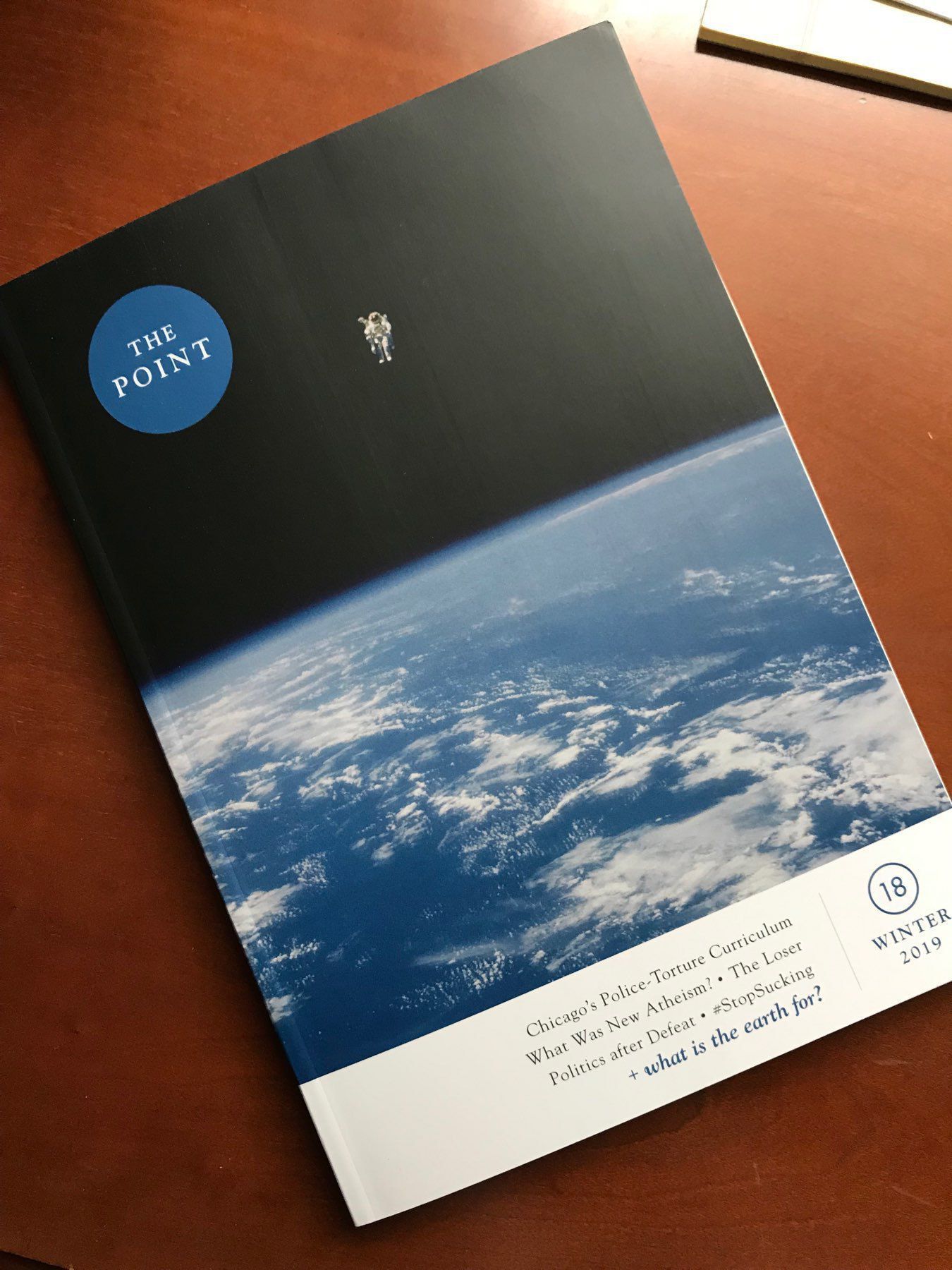
Fabulous new issue of The Point.