
pity the poor referee
There were so many bad calls in the Arsenal-Burnley match I just sweated through that I can’t figure out whether Burnley got hosed. Certainly Arsenal’s late penalty shouldn’t have been granted — Koscielny was clearly offside — but the Xhaka red card was debatable (though I think justified), and earlier in the match Jon Moss clearly missed Mustafi being fouled in the box.
Meanwhile, the outcome of yesterday’s Spurs-Man City clash would surely have been different if Kyle Walker had been appropriately punished for shoving Raheem Sterling in the back as the small man was racing all alone towards goal (that should have been a penalty and a red card). And Mike Dean, recently demoted to the Championship for ineptitude, seems to be continuing his inimitable stylings in his new setting.
All that said, Mark Clattenburg is clearly right when he says that the refs get the overwhelming majority of calls right and that disproportionate attention is given to the ones they get wrong — though he might have noted that some decisions have disproportionate effects: Jon Moss’s decisions today could possibly affect Arsenal’s hopes to stay in the Champions’ League (and maybe even Burnley’s ability to stay up, though I expect that they’re quite safe).
In any event, I think the most important point to note about this ongoing brouhaha is this: The refs are as good as they’re going to get. A great many people want to referee football at the highest level, and they go through considerable training and intense competition to get there. It is highly unlikely that there’s a substantial group of people out there who could do the job better than Clattenburg and Moss and Andre Marriner et al; or that the current crop of refs could be trained in new ways that would significantly improve their performance.
No: the athletes are better-conditioned and faster than they have ever been, there are 22 of them on the pitch, and the pitch is vary large. Calls will be missed, and the percentage of calls missed is highly unlikely to decline. So the moguls of international soccer effectively have three choices: they can shrug and tell us all to deal with an imperfect world, they can add one or more officials, or they can look for technological means to implement in-match corrections of errors.
But there’s really no point in complaining about the refs. They’re not just doing the best they can, they’re probably doing the best anyone can.
gonna be a fabulous four years
Media: We are outraged by the behavior of the Trump administration!
Trump administration: We are outraged by your completely biased and unwarranted outrage!
M: Your outrage at our totally warranted outrage is totally unwarranted, and frankly, we are outraged!
T: Nothing could possibly be more outrageous than your outrage at our totally warranted outrage at your totally unwarranted outrage at our perfectly appropriate behavior!
M: Frankly, your outrage at our outrage at …
The frustration is understandable, but the sooner that the press come to accept that Trump and his minions will never, ever tell the truth unless it’s in their direct interest, the better it will be for all of us.
Reading Calvin
Lately I’ve been trying to read John Calvin, and I’m struggling. When I was in graduate school I read the whole of the Institutes, and as I recall I did so with interest and at least some profit, but now … it’s hard.
People who love Calvin often say that his thinking and theology must be clearly distinguished from the use later made of them. If certain Calvinists are dour, rigid, cold, insensitive to the human condition, prone to make vast theological generalizations from a handful of biblical passages while ignoring the greater part of the biblical witness, those vices should not be attributed retrospectively to Calvin. Which is certainly true, and something I try to keep in mind. But as I read Calvin now, I consistently find him to be dour, rigid, cold, insensitive to the human condition, and prone to make vast theological generalizations from a handful of biblical passages while ignoring the greater part of the biblical witness.
I am not at all sure I’m being fair to Calvin. I would like to think that as I get older I become a better reader, because I know more and have more experience. (Don’t we all like to think that of ourselves?) But experience is a two-edged sword. In the decades since I first read the Institutes I’ve had a great deal of experience with Calvinists, or people who claim to be Calvinists, and with some notable exceptions it hasn’t been pleasant. (In general, and for whatever reason or set of reasons, I found the Calvinists I met at Calvin College far more generous and humane — far more attuned to the spirit of Christ, at least as I discern it — than the Calvinists I met at Wheaton College. And in an environment that’s not wholly Calvinist, self-consciously Calvinist undergrads can be enormously troublesome, because they believe, and tell everyone who will listen, that they and they alone have the honesty and courage to face the hard truths of the Bible….)
But I digress. The point today is that I am simply unable to isolate my reading of Calvin from those several decades of experience (both in person and in reading) with people who admire and see themselves as followers of Calvin. It is possible that this background is actually helpful: for instance, perhaps if generations of readers have discerned certain implications in Calvin’s work, then they’ve seen something that’s really there, for good or ill, and I would do well to be attentive to it. But it seems to me more likely that Calvin’s successors, being less gifted than he, are drawing less subtle and nuanced conclusions than he did. And if that is the case, then my years of experience may be making me a less successful reader of Calvin than I was thirty years ago — at least in certain ways. (What I’ve learned about theology and church history in the intervening years has to be worth something.)
In any event, as I read I keep telling myself read this as though it’s new to you, as though you have no idea who John Calvin is — but it’s not working very well. I find myself longing to turn to Thomas Aquinas, whom I find infinitely more simpatico. But I shall persevere — both in reading Calvin and in trying to understand what it means to be a good reader.
a helpful reminder of the way we were
Imagine if this happened today: Hundreds of young Americans—white, black, and Hispanic—disappear from their everyday lives and secretly form urban guerrilla groups. Dedicated to confronting the government and righting society’s wrongs, they smuggle bombs into skyscrapers and federal buildings and detonate them from coast to coast. They strike inside the Pentagon, inside the U.S. Capitol, at a courthouse in Boston, at dozens of multinational corporations, at a Wall Street restaurant packed with lunchtime diners. People die. They rob banks, dozens of them, launch raids on National Guard arsenals, and assassinate policemen, in New York, in San Francisco, in Atlanta. There are deadly shoot-outs and daring jailbreaks, illegal government break-ins and a scandal in Washington....In fact, the most startling thing about the 1970s-era underground is how thoroughly it has been forgotten. “People always ask why I did what I did, and I tell them I was a soldier in a war,” recalls a heralded black militant named Sekou Odinga, who remained underground from 1969 until his capture in 1981. “And they always say, ‘What war?’”…
“People have completely forgotten that in 1972 we had over nineteen hundred domestic bombings in the United States,” notes a retired FBI agent, Max Noel. “People don’t want to listen to that. They can’t believe it. One bombing now and everyone gets excited. In 1972? It was every day. Buildings getting bombed, policemen getting killed. It was commonplace.”
— Bryan Burrough, Days of Rage
sage quotation for the new political era
Did you ever feel that there was a net cast over us and we were all held in this net by a hegemony of spiders as yet unidentified?
— R. A. Lafferty, Fourth Mansions
no pleasant harmony
Those who hope in Christ can no longer put up with reality as it is, but begin to suffer under it, to contradict it. Peace with God means conflict with the world, for the goad of the promised future stabs inexorably into the flash of every unfulfilled present.… That we do not reconcile ourselves, that there is no pleasant harmony between us and reality, is due to our unquenchable hope. This hope keeps man unreconciled, until the great day of the fulfillment of all the promises of God. It keeps him in statu viatoris, in that unresolved openness to world questions which has its origin in the promise of God in the resurrection of Christ and can therefore be resolved only when the same God fulfills his promise. This hope makes the Christian Church a constant disturbance in human society, seeking as the latter does to stabilize itself into a "continuing city." It makes the Church the source of continual new impulses towards the realization of righteousness, freedom and humanity here in the light of the promised future that is to come.
— Jürgen Moltmann, Theology of Hope
fighting
Kruse: Michael, in your book, and other places, too, he has talked about how much he enjoys fighting. And he certainly fought a lot of people throughout the campaign, and he hasn’t stopped fighting. From Meryl Streep to the intelligence community, he’s still picking fights. Do you think he is going to pick fights with leaders of other countries? In other words, is there any indication that he would be able to separate the interests of the country now from his own personal pique?Blair: Zero.
O’Brien: Absolutely not. There will be no divide there.
— From an interview with Trump biographers in Politico. This seems incontestably true to me, and the most worrisome of the hundred or so worrisome things about Trump. As with toddlers — and Trump is emotionally a toddler — it’s difficult to know in advance what will trigger his rage. And as Michael Brendan Dougherty wrote recently, this temperament in Trump comes accompanied by a fascination with nuclear weapons.
Of all the American Presidents so far, Donald Trump is, beyond question, the least qualified to hold the office. Indeed, he possesses not one single qualifying trait. But it is his inability to control his temper when personally affronted that most clearly marks his utter unfitness.
Most of the people I hear from who are as hostile to the Trump presidency as I am want to make frontal attacks on him, and want their political representatives and other leaders to do so as well. I think that’s a bit like poking a sleeping skunk with a stick. (A skunk with access to nuclear codes.) I am hoping that Trump’s more powerful enemies and critics will show more emotional discipline than he does, and will realize the futility of playing his game by his rules. I am hoping for the creation of fences and funnels, relatively soft nudges of the new President away from danger and temptation.
But I don’t know who’s going to create those fences and funnels. My sense is that the GOP leaders like being in power so much that they’re more likely to imitate Trump than resist him — witness Rance Priebus not-so-subtly threatening a government ethics official for doing his job. That’s a page right out of the Donald’s book. Meanwhile, the left is continuing with its old traditions of preferring symbolic gestures and ideological purity tests to meaningful action. Together the left and right are doing their best to ensure that we’ll have eight years of Trump rather than four.
So where can I place my hope? I actually think there’s a good chance that Trump won’t want more than four years of the straitjacket of the Presidency. I can see — I am even tempted to predict — that three years into his term Trump will declare that he has set America firmly on the path to renewed greatness and is ready to turn the reins over to his trusty sidekick Mike Pence.
A Lover's Question
One of the wonderful things about the music of the late 1950s is the way that it can blend the genres and cultures we’re used to. Elvis’s debt to black music is the most-often-given example, but there’s also Buddy Holly, who famously was thought to “sound black.”
To me, though, the best example of this mixing of genres is one of the very finest songs of the decade, “A Lover’s Question,” written by the great Brook Benton and sung by the equally great Clyde McPhatter:
What is this song? It’s mostly R&B, it’s almost doo-wop, and there are strong elements of country music in it — indeed, with some relatively minor changes in arrangement it could’e been sung by Hank Snow or Ferlin Husky. For people like me who grew up in the deep South, this kind of cultural mixing is deeply meaningful and endlessly fascinating, and our Bible is David Hackett Fischer’s Albion’s Seed, especially the fourth part.
But hey, even if you don’t care about any of that, “A Lover’s Question” is indubitably a great, great song. You’ll give it a listen if you know what’s good for you.
performative anxiety
If you say that the election of Donald Trump to the presidency is an existential threat to this nation, or at least to the more vulnerable within it, and that women in particular must stand up against this misogynistic buffoon, but you refuse to allow pro-life women to join your march — then how worried are you really?
fake news, 1902 edition
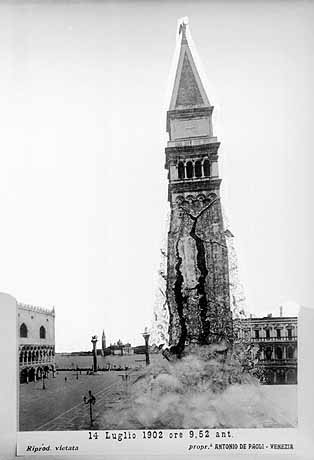
A doctored photo claiming to show the moment that the campanile of St. Mark’s in Venice collapsed. Reproduced all over the world.
