Whenever a college or professional football player commits some act of violence — against a woman, against a dog, against some dude in a bar at two in the morning, against an opponent on or off the field — here’s what the coaching staff and other team officials say:
"We take offenses like this seriously. Very seriously."
"We've talked to X. We'll handle it in house."
"X is a great teammate, really a great guy, everybody loves him. He's not that kind of person."
"What X did is not in any way representative of our guys and who we are as a program."
"To prove how seriously we take this kind of thing, we're gonna make X sit out the first quarter of our game against Southwest Technical College."
Cambridge University Press recognizes the importance of making its web services available to the largest possible audience and has attempted to design and develop this website to be accessible by most users. However some of the resources are only accessible on a Windows based computer.
Russell makes a great point here, and that raises a question: What if there’s a causal connection between their institutional comnmitments and their faithfulfulness? That is, what if Christians who stick, patiently and stoically, with deeply flawed institutions thereby form themselves in such a way that they reap benefits in other venues? Maybe patience and forebearance and firmness of purpose are transferable virtues.
N.B. I write this as someone not known for those virtues.
[gallery]
Yesterday morning at 8:00 a.m. local time, in five cities around the U.S., the anarchist collective INDECLINE erected five copies of a nude polychrome statue of Donald Trump. The New York City copy went up in Union Square, but was removed after about two hours by the Parks Department, whose spokesman Sam Biederman explained that “NYC Parks stands firmly against any unpermitted erection in city parks, no matter how small”.
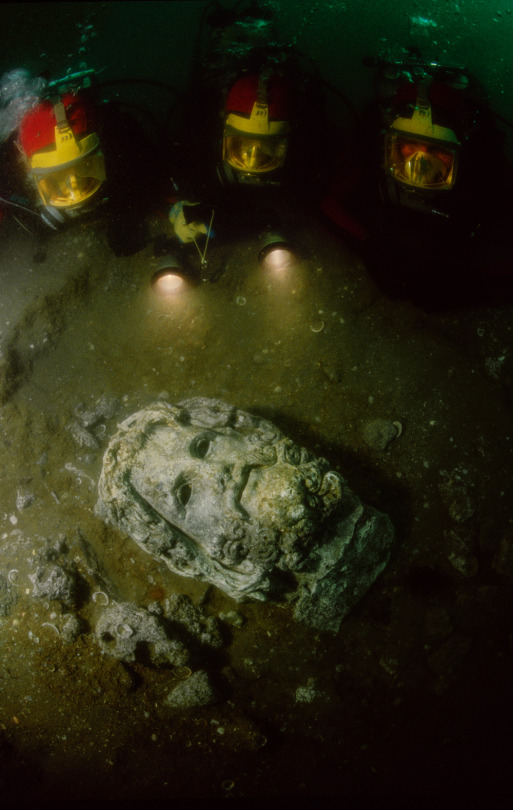
This head depicting the Greco-Egyptian god Serapis is from a colossal statue that stood over 4 metres tall. The statue is thought to be from the Temple of Serapis, a huge sanctuary measuring 101 metres by 78 metres, which once stood in the ancient Egyptian city of Canopus. The impressive remains of this sanctuary were recently discovered by underwater archaeologists led by Franck Goddio.
In this statue, Serapis wears his characteristic headdress, a corn measure known as a kalathos, symbolising abundance and fertility. Alongside his funerary and royal roles, Serapis was worshipped for his healing powers, which according to ancient historians were particularly potent in Canopus. People came from afar to sleep within the temple complex in order to be healed by ‘incubation’, when miraculous cures were delivered in a dream.
The god Serapis is said to have been introduced to Egypt by the ancient Greek ruler Ptolemy I. Serapis was aimed at Greeks living in Egypt and his worship developed where Greek presence was prevailing, notably in Alexandria and Canopus. The popularity of this universal god also flourished outside Egypt in the Greek Mediterranean world, then later in the Roman Empire.