
All
When Ford rolls out a new pickup truck, the CEO generally doesn’t go around giving keynote addresses about how much more lethal it will make American highways. But the AI industry is selling a narrative — a mythos, if you will — as much as it’s selling a product, and that narrative is one of revolutionary, transformational power. “Our product can make your life a bit easier, although there are still a lot of kinks to iron out” is not a trillion-dollar sales pitch; “we’ve invented something so powerful that it has the potential to destroy humanity” is. The company that can end the world controls the future, and investors will spend big on that upside bet. After all, if the world ends, an investor’s losses won’t matter anyway.

Illustrations by Bruno Bamanti for an edition of Caesar's Gallic Wars: 
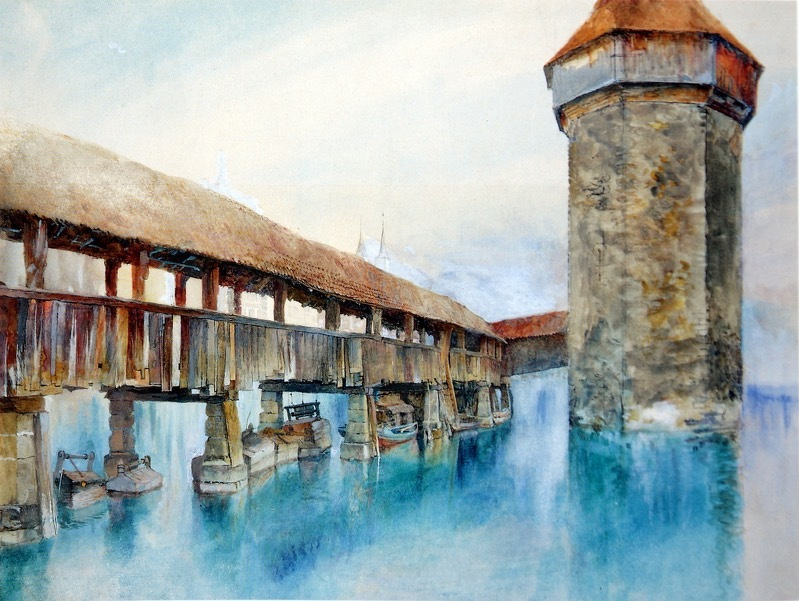
John Ruskin, The Kapellbrücke, Lucerne (1857)

the productivity gains from coding agents are not evenly distributed. they’re split along a k-shape: senior engineers are getting meaningfully more productive. junior engineers are, at best, treading water. at worst, they’re getting worse.
This is exactly what we should expect. You have to be experienced (as a coder, as a researcher, as a thinker) to discern hallucinations and fakery. Only experience will make that alarm bell ring in your head. Younger and less experienced coders/scholars/writers will uncritically accept whatever their preferred chatbot offers them, and that will all too often lead them into more and more profound errors.
If we remove phones without rebuilding the social architecture that once gave childhood meaning, agency, and joy, we risk leaving kids with less stimulation but not more formation.

TEXAS! (by Erin Newman-Mitchell)
How AI Swarms Are Disrupting Democracy: I’m wondering whether the emergence of these swarms will finally prompt people to ask whether social media platforms are appropriate sources of information. Probably not, but I’m grasping at straws here.
We’ve tried over Christian history, in all sorts of ways and contexts, to imitate other kinds of militancy. And my feeling about that is: well that worked, didn’t it! I want to ask: how does Christ change things? One thing I think you can be fairly sure about in the New Testament is that he doesn’t use the techniques of available power systems. ‘This is how the kings of the gentiles work.’ What we do in our militancy for the faith, that is our committed and courageous attempt to witness to what we’ve been given and make it available to others, we do by lives of holiness — which means an awful lot of hard work for the vast majority of us who are nowhere near that level and who resort to shortcuts all the time.
My endorsement of this — and of his comments on the demonic in political life — is absolute.